Question posed to P, forwarded to Trevor:
Science and music together reminds me of John Adams or Phillip Glass (whose stuff I love). Unfortunately, he's a horrible podium speaker who can't really articulate what he's trying to acheive in his compositions, but they are wonderfully complex, especially the symphonies (not so much the operas). They make for good background music for writing. Is your work of a minimalist structure? Would you call it chamber music?
Trevor response:
The style and texture of the music that we will together be building may, in many ways, work and move in ways that are *exactly opposite* to the masterworks of Glass, Reich and their followers working in the New York scene today. Glass's pieces are a pleasure to have on while writing: he departs from (and returns to) repetition as the embodying texture of his music, hence, perhaps, the comfort of writing in the presence of the music. In our case we will be looking through real data from real science at the bench with what we might describe as a hyperattentive eye for *disparity of patterns*; that is, our research together finds both patterns and *different types of* patterns to be a virtue. The resulting music hopes to project a weave of these patterns, one after the other, with gaps in between, and frequently on top of each other all at once. In some sense maybe this sort of work looks at the patterns of Glass, Reich and the minimalist masters and asks "what of a simultaneous, nonsensical understanding of *all these* patterns at once, and even more?"
P back to Trevor:
Beautifully elaborated as always. And exactly the dichotomy between bulk steady state enzymology versus non-equilibrium single molecule enzymology. Glass would be the former, an averaged pattern that is intuitive and sensical. In our work there may be a crowd, but of juxtaposed individuals.
Coda back from Trevor:
*bing!*
that would be it, precisely.
Sunday, February 21, 2010

Friday, February 5, 2010
Omnivolution
Transcript of a recent email discussion. On the heels of an afternoon discussion in the Modern that carried over to an evening in Korea town.
Aaron Lee highlighted a viewpoint published recently in the New Scientist:
"Over the aeons of evolutionary time, the interaction of these multiple constraints has produced many viable phenotypes, all compatible with survival and reproduction. Crucially, however, the evolutionary process in such cases is not driven by a struggle for survival and/or for reproduction. Pigs don't have wings, but that's not because winged pigs once lost out to wingless ones. And it's not because the pigs that lacked wings were more fertile than the pigs that had them. There never were any winged pigs because there's no place on pigs for the wings to go. This isn't environmental filtering, it's just physiological and developmental mechanics."
This hit a chord with Trevor and me, who have been lamenting the intellectual laziness of academic biologists and popular science writers, alike, who use the theory of evolution as a mindlessly applied coda and rationalization for everything from behavior to flower petals.
Trevor's reply:
LOVE IT. OMG LOVE IT.
Why, I hear you ask? Because the public discourse so desperately needs effective narratives in biology that point to something *other than* evolution as cause.
You know, normal people never got over teleology. Student of Aristotle: "Why does an acorn fall to the ground?" Aristotle: "Because of its inner potential, its arete. The acorn *wants to* fall towards the ground." Weird, yes. But notice, especially in biology: "Why does the heart beat?" "To pump blood."
Really?
Really to pump blood?
Whatever else is going on, the heart beats in response to nervous impulse originating from multiple other sites in the body. But then this is frustrating: turtles, all the way down.
SO INSTEAD, the New York Times, among others, have decided that the answer to literally every question in science reporting -- especially reporting on issues in biology -- is due to evolution, by which they mean (and understand) only selection pressure, to the exclusion of all the other factors of macroevolution that could matter. Why does the heart beat? Because a beating heart was *evolutionarily advantageous*. (It works even better if an already-formed image of humans hunting or mating can be pulled into the picture because popular discussion of evolution always everywhere takes place against a silent cartoon backdrop at the level of the Flintstones: well, you see, long quadraceps meant that man was able to run faster to kill prey, and that's why their evolutionary adapted; or if not for running, then to hunt down women and pass on his genes.)
Grrr.
First, it's a danger to understand evolution as a (19th-century) narrative of individuals. Evolution doesn't care about the narrativity (or not) of individuals; it cares about the sum genetic material lodged in *POPULATIONS*.
Second, the reason a lot of shit exists in the world is because a lot of shit is possible to *grow from patterns* ... patterns that, in probably most cases, haven't ever been the subject of selection pressures. The difference between a 2-, 3- or 4-chambered heart probably has, indeed, been the target of millions of years of selection pressure. But finding of every result in neurobiology (or dietary genetics, or human locomotion, and on and on) shouldn't always everywhere -- and unreflectingly -- be assumed the result of selection pressure.
* * *
Which is why I like the quote above.
:)
And mine:
Aaron, as you can see, you touched upon one of Trevor and my "pet topics." My favorite part of the article is when they broke from the scholarly tone to be angry:
"However, the internal evidence to back this imperialistic selectionism strikes us as very thin. Its credibility depends largely on the reflected glamour of natural selection which biology proper is said to legitimise. Accordingly, if natural selection disappears from biology, its offshoots in other fields seem likely to disappear as well. This is an outcome much to be desired since, more often than not, these offshoots have proved to be not just post hoc but ad hoc, crude, reductionist, scientistic rather than scientific, shamelessly self-congratulatory, and so wanting in detail that they are bound to accommodate the data, however that data may turn out. So it really does matter whether natural selection is true."
---
Having said that, I have to take a step back and be critical of the authors. Of most significance: Darwin was the first to point out the limitations and potential pitfalls of his theories. So, I tend to be annoyed with the Darwin deists as much as I am with his detractors. Like with all good religions: NO ONE ACTUALLY READS DARWIN. At least not anymore. That is why I have made a habit of working my way slowly through his writings.
I prepared a lecture for my colleagues in Cambridge on this topic and also on why Lamarck wasn't as silly as BIO 101 course books make him out to be. In fact, Darwin had read and respected many of Lamarck's original thoughts on evolution, namely soft inheritance: that heritable changes can occur during the lifetime of an organism, not just during the transition for organism to organism. It isn't as simple as giraffes and tall trees, but it is still compelling and an important part of the puzzle for understanding inheritance and evolution. The plan can change mid-stream, and that can be inherited.
Aaron Lee highlighted a viewpoint published recently in the New Scientist:
"Over the aeons of evolutionary time, the interaction of these multiple constraints has produced many viable phenotypes, all compatible with survival and reproduction. Crucially, however, the evolutionary process in such cases is not driven by a struggle for survival and/or for reproduction. Pigs don't have wings, but that's not because winged pigs once lost out to wingless ones. And it's not because the pigs that lacked wings were more fertile than the pigs that had them. There never were any winged pigs because there's no place on pigs for the wings to go. This isn't environmental filtering, it's just physiological and developmental mechanics."
This hit a chord with Trevor and me, who have been lamenting the intellectual laziness of academic biologists and popular science writers, alike, who use the theory of evolution as a mindlessly applied coda and rationalization for everything from behavior to flower petals.
Trevor's reply:
LOVE IT. OMG LOVE IT.
Why, I hear you ask? Because the public discourse so desperately needs effective narratives in biology that point to something *other than* evolution as cause.
You know, normal people never got over teleology. Student of Aristotle: "Why does an acorn fall to the ground?" Aristotle: "Because of its inner potential, its arete. The acorn *wants to* fall towards the ground." Weird, yes. But notice, especially in biology: "Why does the heart beat?" "To pump blood."
Really?
Really to pump blood?
Whatever else is going on, the heart beats in response to nervous impulse originating from multiple other sites in the body. But then this is frustrating: turtles, all the way down.
SO INSTEAD, the New York Times, among others, have decided that the answer to literally every question in science reporting -- especially reporting on issues in biology -- is due to evolution, by which they mean (and understand) only selection pressure, to the exclusion of all the other factors of macroevolution that could matter. Why does the heart beat? Because a beating heart was *evolutionarily advantageous*. (It works even better if an already-formed image of humans hunting or mating can be pulled into the picture because popular discussion of evolution always everywhere takes place against a silent cartoon backdrop at the level of the Flintstones: well, you see, long quadraceps meant that man was able to run faster to kill prey, and that's why their evolutionary adapted; or if not for running, then to hunt down women and pass on his genes.)
Grrr.
First, it's a danger to understand evolution as a (19th-century) narrative of individuals. Evolution doesn't care about the narrativity (or not) of individuals; it cares about the sum genetic material lodged in *POPULATIONS*.
Second, the reason a lot of shit exists in the world is because a lot of shit is possible to *grow from patterns* ... patterns that, in probably most cases, haven't ever been the subject of selection pressures. The difference between a 2-, 3- or 4-chambered heart probably has, indeed, been the target of millions of years of selection pressure. But finding of every result in neurobiology (or dietary genetics, or human locomotion, and on and on) shouldn't always everywhere -- and unreflectingly -- be assumed the result of selection pressure.
* * *
Which is why I like the quote above.
:)
And mine:
Aaron, as you can see, you touched upon one of Trevor and my "pet topics." My favorite part of the article is when they broke from the scholarly tone to be angry:
"However, the internal evidence to back this imperialistic selectionism strikes us as very thin. Its credibility depends largely on the reflected glamour of natural selection which biology proper is said to legitimise. Accordingly, if natural selection disappears from biology, its offshoots in other fields seem likely to disappear as well. This is an outcome much to be desired since, more often than not, these offshoots have proved to be not just post hoc but ad hoc, crude, reductionist, scientistic rather than scientific, shamelessly self-congratulatory, and so wanting in detail that they are bound to accommodate the data, however that data may turn out. So it really does matter whether natural selection is true."
---
Having said that, I have to take a step back and be critical of the authors. Of most significance: Darwin was the first to point out the limitations and potential pitfalls of his theories. So, I tend to be annoyed with the Darwin deists as much as I am with his detractors. Like with all good religions: NO ONE ACTUALLY READS DARWIN. At least not anymore. That is why I have made a habit of working my way slowly through his writings.
I prepared a lecture for my colleagues in Cambridge on this topic and also on why Lamarck wasn't as silly as BIO 101 course books make him out to be. In fact, Darwin had read and respected many of Lamarck's original thoughts on evolution, namely soft inheritance: that heritable changes can occur during the lifetime of an organism, not just during the transition for organism to organism. It isn't as simple as giraffes and tall trees, but it is still compelling and an important part of the puzzle for understanding inheritance and evolution. The plan can change mid-stream, and that can be inherited.
Monday, November 2, 2009
Visual
This was amazing. And made me think we should be open to incorporating a visual component to the performance of our project. Building perhaps on the idea of single molecule data (the actual on/off blinkings of the FRETing fluorophores) and the fluorescent score. Other images that come to mind, the perpetual motion of sperm plus egg to cleavage divisions to fetus adult then full circle with sperm and egg. Though the latter should not be too literal, but rather a template.
Local rules, global patterns
Let's discuss more about emergent behavior,
"The system would use local rules between interacting agents to create higher-level behavior well suited to its environment."
"The system would use local rules between interacting agents to create higher-level behavior well suited to its environment."
Thursday, September 3, 2009
Thursday, January 15, 2009
Dichotic listening 2
Alan Cruttendon writes, in his book-length treatment of the prosody in language, Intonation, published 1997 by Cambridge University Press, the following:
"While the links between intonation and punctuation apply, of course, only to literate societies, the links between intonation and gesture are of an altogether more primitive sort. That intonation is a unique part of language is clearly demonstrated from experiments in dichotic listening. In this sort of experimentation similar auditory material is fed to the two ears and the listener shows a preference for the material presented to one ear. For language generally, for tone in tone languages, and even for consonant-vowel nonsense syllables, an advantage is shown for the right ear, which involves the left hemisphere of the brain; whereas a left ear (right hemisphere) advantage is shown for intonation, along with music and general environmental noises. So it is not surprising that in a large majority of cases of acquired language disorders, and even in cases of severe phonological or grammatical disorder, intonation is unaffected. In those few cases in which intonation is affected, patients may well have gestural problems as well. This suggests a close connection between intonation and gesture." [177]
Dichotic listening?
What about the listening of sound refracted through the hundred tiny lenses of the eye of the fly? What becomes of listening passed through the compound eye that, per force, must reassemble its contents in the form of a mosaic? Through the pincers of a dichotomy we come only to the doorstep of gesture, and of shape.
"While the links between intonation and punctuation apply, of course, only to literate societies, the links between intonation and gesture are of an altogether more primitive sort. That intonation is a unique part of language is clearly demonstrated from experiments in dichotic listening. In this sort of experimentation similar auditory material is fed to the two ears and the listener shows a preference for the material presented to one ear. For language generally, for tone in tone languages, and even for consonant-vowel nonsense syllables, an advantage is shown for the right ear, which involves the left hemisphere of the brain; whereas a left ear (right hemisphere) advantage is shown for intonation, along with music and general environmental noises. So it is not surprising that in a large majority of cases of acquired language disorders, and even in cases of severe phonological or grammatical disorder, intonation is unaffected. In those few cases in which intonation is affected, patients may well have gestural problems as well. This suggests a close connection between intonation and gesture." [177]
Dichotic listening?
What about the listening of sound refracted through the hundred tiny lenses of the eye of the fly? What becomes of listening passed through the compound eye that, per force, must reassemble its contents in the form of a mosaic? Through the pincers of a dichotomy we come only to the doorstep of gesture, and of shape.
Dichotic listening 1
It was in August that I listened to Steve Takasugi's Der Fliegenpapier the first time. The piece flickers back and forth between German and English readings of Robert Musil's text of the same name, working in, about and through a carefully assembled (and then reassembled) milieu of words, parts of words and sounds.
Musil's text is a page a half long, maybe two. A full reading takes the narrator, composer and poet Wieland Hoban, only part of what becomes a six-minute piece. Wieland is German / English bilingual and reads both versions of the text.
German Fliegenpapier is English flypaper and there's a sense in which the inter- and admixture to which Takasugi subjects Wieland's spoken-word recordings creates a type of linguistic stickiness: parts, and sometimes only parts, of language inhere such that the affect of language reception changes during the course of the piece. Moments of clarity, instants of pulverization, stretches of such complete and unexpected linguistic hybridization such that — at intervals — the historic development from Old High Gothic into the present unravels.
Dozens of cuts between languages, between texts, in the first seconds of the piece. Announcement — or pronouncement — of title. Der Fliegenpapier / The Flypaper ... Pronouncement that sets into motion the uneasy relationship between the spoken word and the three or four different sense of text active about the work: Why pronouncement? Why here? Any number of European art songs from any number of centuries treat the entirety of some text. But never, whether at beginning or end, the pronouncement of title. A strange reading-aloud.
Sounds, images and bodies multiply. And so some months ago I became another something hovering about Musil's texts, and Takasugi's piece. And now comes the opportunity to shape words into the form of a listened pathway through this constellation.
I'll put some bits of writing here. And I'll start with with an idea of dichotic listening.
What parts of the word, the syllable, or the parts of the syllable, shine through a thousand cuts? It depends on the nature of the cuts and the nature of the reading. And in Wieland's careful treatment we perceive the spoken contour of the phrase. We hear where sentences begin and end amid cuts back and forth between languages, and between text. Form — in the up-and-down shaping of the sentence — at the level of the midground becomes perceptible through a flurry of cuts at the level of the foreground.
It is Alan Cruttendon who will suggest to us a dichotic listening as we assemble instead a fragmented listening. And it is from him that I'll quote in the next post.
Musil's text is a page a half long, maybe two. A full reading takes the narrator, composer and poet Wieland Hoban, only part of what becomes a six-minute piece. Wieland is German / English bilingual and reads both versions of the text.
German Fliegenpapier is English flypaper and there's a sense in which the inter- and admixture to which Takasugi subjects Wieland's spoken-word recordings creates a type of linguistic stickiness: parts, and sometimes only parts, of language inhere such that the affect of language reception changes during the course of the piece. Moments of clarity, instants of pulverization, stretches of such complete and unexpected linguistic hybridization such that — at intervals — the historic development from Old High Gothic into the present unravels.
Dozens of cuts between languages, between texts, in the first seconds of the piece. Announcement — or pronouncement — of title. Der Fliegenpapier / The Flypaper ... Pronouncement that sets into motion the uneasy relationship between the spoken word and the three or four different sense of text active about the work: Why pronouncement? Why here? Any number of European art songs from any number of centuries treat the entirety of some text. But never, whether at beginning or end, the pronouncement of title. A strange reading-aloud.
Sounds, images and bodies multiply. And so some months ago I became another something hovering about Musil's texts, and Takasugi's piece. And now comes the opportunity to shape words into the form of a listened pathway through this constellation.
I'll put some bits of writing here. And I'll start with with an idea of dichotic listening.
What parts of the word, the syllable, or the parts of the syllable, shine through a thousand cuts? It depends on the nature of the cuts and the nature of the reading. And in Wieland's careful treatment we perceive the spoken contour of the phrase. We hear where sentences begin and end amid cuts back and forth between languages, and between text. Form — in the up-and-down shaping of the sentence — at the level of the midground becomes perceptible through a flurry of cuts at the level of the foreground.
It is Alan Cruttendon who will suggest to us a dichotic listening as we assemble instead a fragmented listening. And it is from him that I'll quote in the next post.
Sunday, December 28, 2008
Autofluorescence as artifact
What happens when the probably brighter reflective or refractive light of the microscopic slide supersedes the fleeting light of the fluorophore that we use to render the microscopic subject? We take autofluorescence as artifact. As interference. As noise. As the cause of an unwilling suspension of the gaze.
What, then, constitutes the "real" in the dialectic played out in and on the visible of the slide? The effects, it would appear, of photosensitive dye. And so it is that the real gets rewritten as the effects on an injection. As the short-lived effects of a glowing dye.
So there's an attraction here. The potential of an induced autofluorescence. A xenographic encoding on the surface of the slide. An inscription prior to seeing. And a willing redirection of the gaze.
What happens when the light of the microscopic slide becomes the subject of the microscopic slide? We then take autofluorescence as subject. As carrier. As the deliverer of some foreign message.
What's interesting here is the idea of the long-standing physical attributes of glass acting as a type of inhibitor, or limiter, over what it is that glass lets us see in the first place. When we inscribe the surface of the slide to encourage this type of internal glow we cut a channel through our own field of sight.
What, then, constitutes the "real" in the dialectic played out in and on the visible of the slide? The effects, it would appear, of photosensitive dye. And so it is that the real gets rewritten as the effects on an injection. As the short-lived effects of a glowing dye.
So there's an attraction here. The potential of an induced autofluorescence. A xenographic encoding on the surface of the slide. An inscription prior to seeing. And a willing redirection of the gaze.
What happens when the light of the microscopic slide becomes the subject of the microscopic slide? We then take autofluorescence as subject. As carrier. As the deliverer of some foreign message.
What's interesting here is the idea of the long-standing physical attributes of glass acting as a type of inhibitor, or limiter, over what it is that glass lets us see in the first place. When we inscribe the surface of the slide to encourage this type of internal glow we cut a channel through our own field of sight.
Thursday, December 18, 2008
The Accessible Aquarium
We should keep our eye on this experimental music department at Georgia Tech.
Sunday, November 30, 2008
Triptychs and triplets.
Place holder for follow up on tonight's discussion about Francis Bacon, his triptychs, the triplet nature of codons, your Cedar allergy, medieval spies, the possibility of para-immunity, parasites, the possibility of expanding on the triplet nature of codons, the wobble position, the number 20, and the fact that the ribosome does wild and wonderful things like frameshifting and shunting, so art is not that far off the mark. More soon.
Meanwhile, in perusing some Bacon triptychs, I found a common theme in many of them that the first two heads are oriented in the same direction with the third facing the other two. Thus it seems that the Bacon triptychs, like codon triplets, also have a wobble position. Three examples below.

Meanwhile, in perusing some Bacon triptychs, I found a common theme in many of them that the first two heads are oriented in the same direction with the third facing the other two. Thus it seems that the Bacon triptychs, like codon triplets, also have a wobble position. Three examples below.

Tuesday, November 25, 2008
Julius F. Jezek Prize
Saturday, November 8, 2008
Boy who "sees" with sound.
Blind Boy That Sees Using Sounds Like Dolphins -
Also from my friend. Thought this one is especially pertinent considering our Austin conversation about dolphin linguistics.
Device for visualizing sound.
Shapes Using Sound Effects - video powered by Metacafe
A friend of mine at the Cavendish shared this after visiting the blog.
Hearing heat motion.
Thoughts on Schrodinger's first lecture in What is Life?
Schrodinger begins his exploration into Life with the question of why our bodies are so big compared to an atom. He cites a common frustration among those of us that study the very small, which is that our human senses are insensitive to them. This, as we discussed in August, necessitates that our observations be indirect. He presents an argument as to why it must be this way by explaining the statistical thermodynamic principle that the ordered phenomena we observe (e.g. paramagnetism and diffusion) result from the averaged behavior of independent atoms. These atoms are influenced by thermal fluctuations (he calls them “heat motion”), each other, as well as the force being tested, such as a magnetic field. Therefore, when observed as an ensemble, particles in a magnetic field align with the field. However, if your level of sensitivity was on a single particle scale, the pattern would seem confusing and chaotic. Our senses are thus tuned to relay to our brains, averages. Thus, a paradox that he highlights is that in the process of achieving the level of complexity required to comprehend the concept of a single atom, a human being has lost the ability to sense a single atom.
The perpetuum mobile project thus, strives to restore to us, through the aid of machines, a level of sensitivity that only our most distant unicellular biological relatives still possess: the ability to “hear” heat motion.
Schrodinger begins his exploration into Life with the question of why our bodies are so big compared to an atom. He cites a common frustration among those of us that study the very small, which is that our human senses are insensitive to them. This, as we discussed in August, necessitates that our observations be indirect. He presents an argument as to why it must be this way by explaining the statistical thermodynamic principle that the ordered phenomena we observe (e.g. paramagnetism and diffusion) result from the averaged behavior of independent atoms. These atoms are influenced by thermal fluctuations (he calls them “heat motion”), each other, as well as the force being tested, such as a magnetic field. Therefore, when observed as an ensemble, particles in a magnetic field align with the field. However, if your level of sensitivity was on a single particle scale, the pattern would seem confusing and chaotic. Our senses are thus tuned to relay to our brains, averages. Thus, a paradox that he highlights is that in the process of achieving the level of complexity required to comprehend the concept of a single atom, a human being has lost the ability to sense a single atom.
The perpetuum mobile project thus, strives to restore to us, through the aid of machines, a level of sensitivity that only our most distant unicellular biological relatives still possess: the ability to “hear” heat motion.
Sunday, November 2, 2008


Wednesday, October 22, 2008

Tuesday, October 14, 2008
Friday, September 26, 2008
Reflections
Just got back from the engraver's this morning to look at the final assembly of the pieces I'm sending off to the Chelsea Art Museum for next week's opening of the Notations21 show there. And it's remarkable going back through the process the engraver and I have collectively engineered over the last couple of months to project notation directly into glass.
Dozens and dozens of industrial engraving processes. There are processes for engraving on glass, on metal, on wood, and on every type of stone. There are processes for engraving on concrete and brick and even asphalt. Different types of laser, acid, UV- and photo-reactive film all make an appearance, depending on the detail of the work, whether the product is to be seen indoors or out, the thickness of the engraving target, and the depth and coloration of the resulting incisions in the body of the piece.
The glass panels we've put together for the show in Chelsea are 13 x 19" and engraved with several thousand individual vectors taken from the parts of the score to Reiko's flute piece that we premiered earlier this year in Berlin. The postscript sourcefiles drive a laser powered by the three different highly excitable gases. The laser etches directly into a sticky green film which adheres to the obverse side of each panel. The dots, flags, noteheads, stafflines and other symbols the laser cuts through the film open spaces in the mask and leave the gestalt collection of symbols in the piece open and exposed for the next step in the process, which is treatment with fine, 220-grit sand blown at 90 PSI directly at the back of each panel. Demasking follows -- always done only by hand -- and takes several hours. The entire piece is then washed in an acetone bath and rubbed with a dry cloth.
What results are whitened, calligraphic bits of score code showing back-to-front through completely transparent media.
Backgrounding becomes important. Hold each panel up to black and the symbols pop. Next to white, they evanesce.

There's an ambiguity to all this. Glass makes both the agent and the object of the the traditional microscope, in, respectively, the lens and the slide. What other materials becomes both agent and object of a type of seeing?
And then glass traps whatever may be its contents in equal measure to the degree in which it lets pass our view.
Slides? What do molecular biologists use in place or slides?
Dozens and dozens of industrial engraving processes. There are processes for engraving on glass, on metal, on wood, and on every type of stone. There are processes for engraving on concrete and brick and even asphalt. Different types of laser, acid, UV- and photo-reactive film all make an appearance, depending on the detail of the work, whether the product is to be seen indoors or out, the thickness of the engraving target, and the depth and coloration of the resulting incisions in the body of the piece.
The glass panels we've put together for the show in Chelsea are 13 x 19" and engraved with several thousand individual vectors taken from the parts of the score to Reiko's flute piece that we premiered earlier this year in Berlin. The postscript sourcefiles drive a laser powered by the three different highly excitable gases. The laser etches directly into a sticky green film which adheres to the obverse side of each panel. The dots, flags, noteheads, stafflines and other symbols the laser cuts through the film open spaces in the mask and leave the gestalt collection of symbols in the piece open and exposed for the next step in the process, which is treatment with fine, 220-grit sand blown at 90 PSI directly at the back of each panel. Demasking follows -- always done only by hand -- and takes several hours. The entire piece is then washed in an acetone bath and rubbed with a dry cloth.
What results are whitened, calligraphic bits of score code showing back-to-front through completely transparent media.
Backgrounding becomes important. Hold each panel up to black and the symbols pop. Next to white, they evanesce.

There's an ambiguity to all this. Glass makes both the agent and the object of the the traditional microscope, in, respectively, the lens and the slide. What other materials becomes both agent and object of a type of seeing?
And then glass traps whatever may be its contents in equal measure to the degree in which it lets pass our view.
Slides? What do molecular biologists use in place or slides?

Sunday, September 21, 2008
Beckett in Berio
Mahler. Symphony no. 2, movement III (of V), 1888 - 94.
Marked "In ruhig fliessender Bewegung":
Berio. Sinfonia, movement III (of V), 1968 - 69.
Marked "In ruhig fliessender Bewegung":
"... this represents at least a thousand words I wasn't counting on ..."
Marked "In ruhig fliessender Bewegung":
Berio. Sinfonia, movement III (of V), 1968 - 69.
Marked "In ruhig fliessender Bewegung":
"... this represents at least a thousand words I wasn't counting on ..."
Tuesday, September 16, 2008

Beckett on Biology
My uncle reminded me of the opening lines of The Unnamable this morning. It made me think of you and enzymes and embryonic cell fate decisions:
Where now? Who now? When now? Unquestioning. I, say I. Unbelieving. Questions, hypotheses, call them that. Keep going, going on, call that going, call that on.
Where now? Who now? When now? Unquestioning. I, say I. Unbelieving. Questions, hypotheses, call them that. Keep going, going on, call that going, call that on.
Thursday, September 11, 2008
A decentered biology
So we talk and I have to update image after image and image to keep up. Whatever ideas I have about the mechanics of the passing of secret messages break under the weight of your epigenetics.
DNA is still the repository; check. RNA still transient? Um, kinda. But these 'maternal effect' factors? This stuff that hangs out in the cortex ... who the hell cares about the cortex? I couldn't ante up a damn thing about the cortex. The nucleus is where all the information lives, right? And information equals control, and control is what manages change, and development is change, and so the nucleus is center stage for development ...
Or maybe not.
The cell divides and somewhere by 8 or 16 or something daughter cells differentiation sets in. Something is inside, something is outside. And nowhere in any of the stuff they shoved down our throats in school was there any clue of a reason as to why differentiation actually happened: the daughter cells all have the same DNA, right?
But what if precisely that stuff that's hanging out in the cortex can actually play a role? What if the stuff that's hanging out in the cortex isn't distributed evenly around a too-smooth sphere but actually has a COMPLEX PATTERN -- or maybe better a complex SERIES OF PATTERNS -- to its distribution. And what if the patterning inherent in the distribution of the magic stuff of the cortex matters precisely because the different daughter cells grab different parts of the cortical information as they cleave?
More head blowing up. Because what happens is that the intolerably round, intolerably centered model of the perfect egg dissolves: we can't answer the question of fundamental differentiation when there's too much symmetry, that is, when we think according to too perfect a model. The tyranny of the sphere. What's needed is precisely asymmetry in an amount enough to decenter the model. Enter the edge of the cell as the source and keep of just the asymmetry we need. And we start to explain why we get a head over here but a tail over there.
If this is right -- if magic stuff living in the remote edges of the cell acts as type of control over the all-important information in the central repository that is DNA -- then what we have is a decentered biology. A molecular biology that yields up the secrets of its center in its first 60 years and opens its edges only now.
RNA as the winged messenger. How else to explain how the stuff at the edges -- in the form of these maternal effect factors -- can actually effect control? Stuff, in the form of (m)RNA has to visit the factors present in the cortex. And so a new image: a visit there and back again as critical to development. This is the image of the pilgrimage.
Put it together and the centered repository part of the model sticks around. But the model augments centralization with control from the periphery. All by means of developmental pilgrimage upon developmental pilgrimage.
As you get closer and closer to the image of the epigenome I see colors. Literally. A dusting of green and sapphire specks, scattered rainbow colors in the shadows of the cell, patterned to control, to help, to develop, to break a tyranny of too much symmetry.
DNA is still the repository; check. RNA still transient? Um, kinda. But these 'maternal effect' factors? This stuff that hangs out in the cortex ... who the hell cares about the cortex? I couldn't ante up a damn thing about the cortex. The nucleus is where all the information lives, right? And information equals control, and control is what manages change, and development is change, and so the nucleus is center stage for development ...
Or maybe not.
The cell divides and somewhere by 8 or 16 or something daughter cells differentiation sets in. Something is inside, something is outside. And nowhere in any of the stuff they shoved down our throats in school was there any clue of a reason as to why differentiation actually happened: the daughter cells all have the same DNA, right?
But what if precisely that stuff that's hanging out in the cortex can actually play a role? What if the stuff that's hanging out in the cortex isn't distributed evenly around a too-smooth sphere but actually has a COMPLEX PATTERN -- or maybe better a complex SERIES OF PATTERNS -- to its distribution. And what if the patterning inherent in the distribution of the magic stuff of the cortex matters precisely because the different daughter cells grab different parts of the cortical information as they cleave?
More head blowing up. Because what happens is that the intolerably round, intolerably centered model of the perfect egg dissolves: we can't answer the question of fundamental differentiation when there's too much symmetry, that is, when we think according to too perfect a model. The tyranny of the sphere. What's needed is precisely asymmetry in an amount enough to decenter the model. Enter the edge of the cell as the source and keep of just the asymmetry we need. And we start to explain why we get a head over here but a tail over there.
If this is right -- if magic stuff living in the remote edges of the cell acts as type of control over the all-important information in the central repository that is DNA -- then what we have is a decentered biology. A molecular biology that yields up the secrets of its center in its first 60 years and opens its edges only now.
RNA as the winged messenger. How else to explain how the stuff at the edges -- in the form of these maternal effect factors -- can actually effect control? Stuff, in the form of (m)RNA has to visit the factors present in the cortex. And so a new image: a visit there and back again as critical to development. This is the image of the pilgrimage.
Put it together and the centered repository part of the model sticks around. But the model augments centralization with control from the periphery. All by means of developmental pilgrimage upon developmental pilgrimage.
As you get closer and closer to the image of the epigenome I see colors. Literally. A dusting of green and sapphire specks, scattered rainbow colors in the shadows of the cell, patterned to control, to help, to develop, to break a tyranny of too much symmetry.
Wednesday, August 20, 2008
Constructive : Synthesis
It’s interesting you mention Finnish because it is in the Ural-Altaic language group along with my first language, Turkish. I say first, and should probably also say last.
Tuesday, on a balcony overlooking the Golden Horn, I was told the story of a Parisian philosopher, who wrote most of his works in French, was also fluent in German, and who eventually could only communicate in French, then German, and then finally in Romanian (the language of his childhood) as he progressed through the stages of Alzheimer’s. This makes sense given the fMRI studies showing that the cluster of neurons associated with one’s native language is spatially distinct from that of languages learned later in life.
And right there a question arises — do you guys feel yourselves visualizing the abstract or the concrete?
The short answer is the concrete. Which is why I chose noumena over phenomena.
The longer answer is that we like to think we are studying the actual object (in this case the ribosome) however, it is true that in fact we are studying the phenomenon, the appearance of this object to our senses (which in the case of smFRET is our sight). The phenomenon we are observing may directly report on the ribosome, or may be an artifact of the system. This is a question that Scott fields a lot during lectures on his work. Perhaps he will have more to say.
More so, sounds like in plenty of cases we're only going to be able to visualize the (indirect) effects these structures generate on their immediate environment and on other local structures with which they interact ... rather than, say, (direct) observation of the structures themselves.
Yes, our senses evolved to directly observe food and predators and mates. Objects typically (except perhaps if you consider a virus to be a predator) larger than the cell. Therefore, all observation on a subcellular scale is indirect in the sense that we require tools to mediate the observation.
So, yes, we are model guided from beginning to end. And that is one of the goals of this project: to push the boundaries of biological observation. To add a new sense to the toolbox. We have well-established indirect methods of seeing things smaller than light. I’m hoping through this collaboration we can also start to hear things smaller than light.
So that's where the friction — the constructive friction — will lie. In the language of research (and questions about research) rubbing up against the language of composition (and questions about composition) as the work progresses.
Yes, and before friction comes contact. The earliest enzymology lesson I learned was that in order to react, two objects first must bind. Corpora non agunt nisi ligata. In fact, one of the principle functions of an enzyme is to accelerate the process of bringing objects together. Thus by extension, it is not surprising that it is an enzyme, the ribosome, that is bringing us together for (I would argue rather than friction) a constructive reaction, a synthesis.
Tuesday, on a balcony overlooking the Golden Horn, I was told the story of a Parisian philosopher, who wrote most of his works in French, was also fluent in German, and who eventually could only communicate in French, then German, and then finally in Romanian (the language of his childhood) as he progressed through the stages of Alzheimer’s. This makes sense given the fMRI studies showing that the cluster of neurons associated with one’s native language is spatially distinct from that of languages learned later in life.
And right there a question arises — do you guys feel yourselves visualizing the abstract or the concrete?
The short answer is the concrete. Which is why I chose noumena over phenomena.
The longer answer is that we like to think we are studying the actual object (in this case the ribosome) however, it is true that in fact we are studying the phenomenon, the appearance of this object to our senses (which in the case of smFRET is our sight). The phenomenon we are observing may directly report on the ribosome, or may be an artifact of the system. This is a question that Scott fields a lot during lectures on his work. Perhaps he will have more to say.
More so, sounds like in plenty of cases we're only going to be able to visualize the (indirect) effects these structures generate on their immediate environment and on other local structures with which they interact ... rather than, say, (direct) observation of the structures themselves.
Yes, our senses evolved to directly observe food and predators and mates. Objects typically (except perhaps if you consider a virus to be a predator) larger than the cell. Therefore, all observation on a subcellular scale is indirect in the sense that we require tools to mediate the observation.
So, yes, we are model guided from beginning to end. And that is one of the goals of this project: to push the boundaries of biological observation. To add a new sense to the toolbox. We have well-established indirect methods of seeing things smaller than light. I’m hoping through this collaboration we can also start to hear things smaller than light.
So that's where the friction — the constructive friction — will lie. In the language of research (and questions about research) rubbing up against the language of composition (and questions about composition) as the work progresses.
Yes, and before friction comes contact. The earliest enzymology lesson I learned was that in order to react, two objects first must bind. Corpora non agunt nisi ligata. In fact, one of the principle functions of an enzyme is to accelerate the process of bringing objects together. Thus by extension, it is not surprising that it is an enzyme, the ribosome, that is bringing us together for (I would argue rather than friction) a constructive reaction, a synthesis.
Five senses
Five senses, indeed. We only see and hear according to some model. And seeing things in the existence of which we're not yet prepared to accept is a feat. Maybe a reason that moving things in and out of different media can open things we didn't know we're there ...
Been working the last couple of weeks to get music engraved on glass ... something happens when indications for performance jump the page set themselves up to be looked through ...
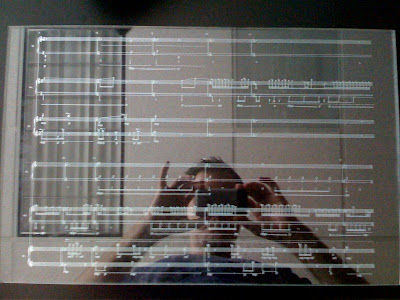
That's a part of the flute, violin & piano trio from February. The glass guy brought the proof by this morning ... glass on black becomes a mirror ... with embedded code. The real work is running as a series of eight engravings and will show at the Chelsea Gallery in New York in October ... so everyone else can see notation hovering somewhere it usually doesn't ...
Been working the last couple of weeks to get music engraved on glass ... something happens when indications for performance jump the page set themselves up to be looked through ...

That's a part of the flute, violin & piano trio from February. The glass guy brought the proof by this morning ... glass on black becomes a mirror ... with embedded code. The real work is running as a series of eight engravings and will show at the Chelsea Gallery in New York in October ... so everyone else can see notation hovering somewhere it usually doesn't ...
Tuesday, August 19, 2008
Dinner reflections
"Per" as a prefix is great, btw. I think the people who study these things label one of the profusion of noun cases in Finnish the "perlative" for things set on some path through a place, a time, or some other thing.
I was in San Diego last week and this weekend working with friends. I'm back now, and I'm thinking about your voicemail. So how'd it go? How was dinner?
Some stuff and some hopes come to mind. We're smashing molecular biology & music together and so we can expect what we might call fruitful model friction, right? You guys have different practices devoted entirely to aspects of visualizing stuff at levels much much smaller than the cell. And right there a question arises — do you guys feel yourselves visualizing the abstract or the concrete? The abstract / concrete thing is probably a false dichotomy under any circumstances ... and it seems especially problematized by the whole premise of molecular visualization ... especially at the level that Scott is pushing it ... and at the level you're pushing at Cambridge, right? Whatever these ribosomal (sub)structures turn out to actually "be" the visualization is always going to be some type of superabstraction. More so, sounds like in plenty of cases we're only going to be able to visualize the (indirect) effects these structures generate on their immediate environment and on other local structures with which they interact ... rather than, say, (direct) observation of the structures themselves. So, fine. One of the implications of proceeding that way is that the visualization is model-governed from beginning to end. Which means that whatever model(s) we can invoke from the way that we think about music — the development and dissolution of musical structures, the perception or reception of those structures by people, or how structure vanishes when we think musically in different ways — carry at least the possibility of friction with whatever models it is that drive the work of visualization in the lab. Which is what we can point to by 'model friction'.
Related thought: language matters in this work. We've got the blog, some trips and possibilities to meet for a reason, and we're opening up times and places to exchange language in the process. So posit for a minute that language use for each of us depends on some graph of whole, fractured or composite concepts that interconnect all over the place in our thinking, and also when we write to each other, and talk. Stuff connects in different ways and the words and syntactic patterns we pick out and avoid when we look at each other's work — sketches, result sets, pics, soundfiles, whatever — probably trigger things for us even before they mean things for us. Which probably comes out to mean that we can sure as hell expect something to tremor or to shake in our thinking when you let a molecular biologist in to critique to the construction and development of the sounds in music as the piece progresses and when you let a composer feed back and react to data of actual results as research progresses.
We carry whatever models it is we have with us as our most powerful tools in the form of learned connections — neural, numeric, sonic, maybe literary. And we communicate whatever it that we carry through our language ... and also the sound and image we embed in and around that language.
So that's where the friction — the constructive friction — will lie. In the language of research (and questions about research) rubbing up against the language of composition (and questions about composition) as the work progresses.
So tell me about dinner ... and whether 'visualization' became a keyword at the table. And then I'll tell you what's frictive in the sketches I'm working on now.
I was in San Diego last week and this weekend working with friends. I'm back now, and I'm thinking about your voicemail. So how'd it go? How was dinner?
Some stuff and some hopes come to mind. We're smashing molecular biology & music together and so we can expect what we might call fruitful model friction, right? You guys have different practices devoted entirely to aspects of visualizing stuff at levels much much smaller than the cell. And right there a question arises — do you guys feel yourselves visualizing the abstract or the concrete? The abstract / concrete thing is probably a false dichotomy under any circumstances ... and it seems especially problematized by the whole premise of molecular visualization ... especially at the level that Scott is pushing it ... and at the level you're pushing at Cambridge, right? Whatever these ribosomal (sub)structures turn out to actually "be" the visualization is always going to be some type of superabstraction. More so, sounds like in plenty of cases we're only going to be able to visualize the (indirect) effects these structures generate on their immediate environment and on other local structures with which they interact ... rather than, say, (direct) observation of the structures themselves. So, fine. One of the implications of proceeding that way is that the visualization is model-governed from beginning to end. Which means that whatever model(s) we can invoke from the way that we think about music — the development and dissolution of musical structures, the perception or reception of those structures by people, or how structure vanishes when we think musically in different ways — carry at least the possibility of friction with whatever models it is that drive the work of visualization in the lab. Which is what we can point to by 'model friction'.
Related thought: language matters in this work. We've got the blog, some trips and possibilities to meet for a reason, and we're opening up times and places to exchange language in the process. So posit for a minute that language use for each of us depends on some graph of whole, fractured or composite concepts that interconnect all over the place in our thinking, and also when we write to each other, and talk. Stuff connects in different ways and the words and syntactic patterns we pick out and avoid when we look at each other's work — sketches, result sets, pics, soundfiles, whatever — probably trigger things for us even before they mean things for us. Which probably comes out to mean that we can sure as hell expect something to tremor or to shake in our thinking when you let a molecular biologist in to critique to the construction and development of the sounds in music as the piece progresses and when you let a composer feed back and react to data of actual results as research progresses.
We carry whatever models it is we have with us as our most powerful tools in the form of learned connections — neural, numeric, sonic, maybe literary. And we communicate whatever it that we carry through our language ... and also the sound and image we embed in and around that language.
So that's where the friction — the constructive friction — will lie. In the language of research (and questions about research) rubbing up against the language of composition (and questions about composition) as the work progresses.
So tell me about dinner ... and whether 'visualization' became a keyword at the table. And then I'll tell you what's frictive in the sketches I'm working on now.
Subscribe to:
Posts (Atom)


 Posts
Posts

